

Not Just Any Port in a Storm – Use a Safe Harbor
Double patenting has its downsides in U.S. practice – terminal disclaimers require maintaining common ownership of the subject patents, and disclaimers can reduce patent term. Moreover, even when a double patenting rejection has not been made during examination, related patents can be invalidated after issuance double patenting grounds, such as when different patents in the same family have different patent term adjustments, such as happened in In re Cellect, 81 F.4th 1216 (Fed. Cir. 2023).
A safe harbor against double patenting exists for divisional applications filed as a result of a restriction requirement, as set forth in 35 USC 121: “A patent issuing on an application with respect to which a requirement for restriction under this section has been made, or on an application filed as a result of such a requirement, shall not be used as a reference either in the Patent and Trademark Office or in the courts against a divisional application or against the original application or any patent issued on either of them, if the divisional application is filed before the issuance of the patent on the other application.” Given the downsides of double patenting rejections, it behooves the savvy applicant to make good use of the safe harbor that the law provides.
However, the 35 USC 121 safe harbor provides some traps for the unwary attempting to make use of it. A good illustrative case is Ex parte Sauerberg, No. 2014-007964 (PTAB Jan. 12, 2017). Sauerberg involved an application with claims to a method of using a composition, the fourth application in a chain that by the time of the appeal had three issued patents on compositions. The method claims in the application on appeal were drawn to methods of use of the compositions patented in the three already-issued patents. Figure 1 below shows the situation in Sauerberg, with Applications 1-3 being the applications that had issued as patents on the composition, with Application 4 being the appealed application with the method claims, and with “RR” indicating the only restriction requirement, requiring selection between composition claims and method claims in Application 1.
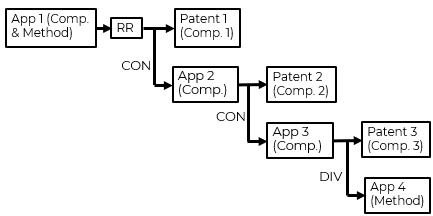
Figure 1
The examiner handling Application 4 (the one drawn to method claims) made obviousness-type double-patenting rejections over all three of the composition patents. Sauerberg argued that he should be given the benefit of the safe harbor provision of 35 USC 121. After all, there was a restriction requirement issued in the first application, between the composition claims and the method claims, and the last application was a divisional application filed as a result of that original restriction requirement, during the pendency of the chain of applications that produced the three patents to composition claims.
Not so fast, said the PTAB. Instead of analyzing the chain of the first three applications as a whole, the PTAB looked at them individually, and found that the method claims application failed to satisfy the safe harbor requirements for any of them.
For the original application, there had indeed been a restriction requirement between the composition claims and the method claims, and the method-claim application was “an application filed as a result of such a requirement.” But the method claims application was not “filed before the issuance of the patent on the other application,” and therefore the 35 USC 121 safe harbor did not apply.
The two composition-claim continuation applications (Applications 2 and 3) also did not satisfy the safe harbor requirements, but for a different reason. They had no restriction requirements in them, so (in the language of 35 USC 121) the method-claim application was not “an application filed as a result of [a restriction] requirement” with regard to these two applications. So Sauerberg had to file a terminal disclaimer to overcome the double patenting rejections, and get the fourth patent issued.
What should have been done to avoid this problem? First of all, the divisional application needs to be filed before the first patent issues, producing the situation shown below in Figure 2. This provides a clear safe harbor against double patenting over Patent 1.
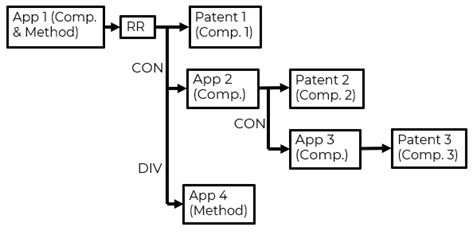
Figure 2
But moving the divisional application forward in time raises a problem. Unless prosecution of the divisional application is delayed, then the divisional application would be prosecuted before the full scope of the composition claims is known. One way of addressing this problem is to file a series of continuations of the divisional application, as illustrated in Figure 3. The safe harbor with regard to Patent 1 is maintained in a series of continuations filed off of the divisional application (Application 4), see Symbol Techs. v. Opticon, 935 F.2d 1569 (Fed. Cir. 1991), and the method-claim continuation applications (Applications 5 and 6) can be used to capture methods of using the compositions that are patented in Patents 2 and 3.
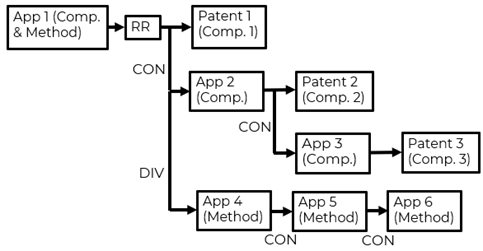
Figure 3
However, there’s still the problem of possible double patenting rejections from Patents 2 and 3, the continuations claiming further compositions. As was the case in the Sauerberg PTAB opinion, there is nothing that provides a safe harbor from double patenting rejections involving Patents 2 and 3, since those applications were not filed or pursued as a result of a restriction requirement, and since applications 4 and 5 were not filed as a result of a restriction in Applications 2 and 3.
To provide a safe harbor from double patent rejections over Patents 2 and 3, it would be necessary to provoke restrictions in Applications 2 and 3 by including method claims in the initial filings of those applications. One way would be to do so and then make Applications 5 and 6 divisional applications, as is shown in Figure 4:
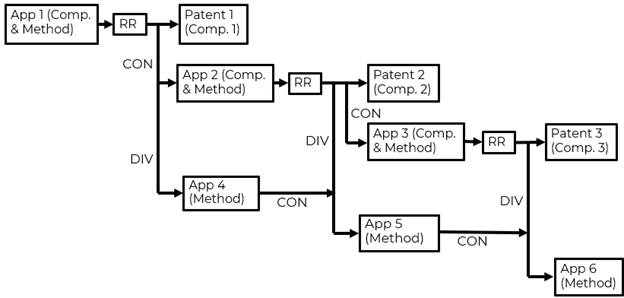
Figure 4
Another (and less costly) approach would be to provoke the same restrictions in Applications 2 and 3, and string out the prosecution of Application 4, adding new method of use claims in Application 4 as the composition claims are allowed in Applications 2 and 3. This is illustrated in Figure 5. (The delay in prosecution of Application 4 may be some combination of suspensions of actions, RCEs, and/or extensions of time.)
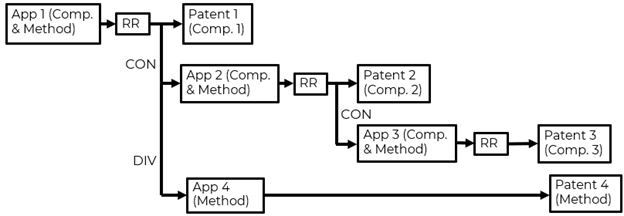
Figure 5
Here the safe harbor may not explicitly apply, but the restriction requirements provoked in Applications 2 and 3 serve as evidence that the USPTO saw the composition claims and method claims as patentably distinct, which should amount to a conclusive shield against double patenting.
The safe harbor against double patenting is tricky. Sauerberg shows the importance of timely filing divisional applications, and the need to provoke restriction requirements (at least sometimes) in subsequent applications.