

Of Dogs and Sprinklers
Dr. Jonathan Platt
Other than dogs, sprinklers don’t have many enemies in the wild. Many dogs see sprinklers, especially rotary sprinklers, as an opportunity for play, and a wet game it is. The result can be a sprinkler damaged by an overenthusiastic canine playmate.
Inventor Paige Porter saw the problem and came up with a solution. See Application 18/905,605, published as US 2025/0221399 A1. The problem and solution were described in broad terms in the application, as protecting “yard items” from “[w]ild animals and even domestic pets such as dogs and cats.” But the claims are limited to a system for protecting a sprinkler with a rotary nozzle, and when it comes to such a sprinkler let’s be frank – wild animals have more important things to do than play with a sprinkler (with the possible exception of raccoons, who will find a way to cause trouble with just about anything), and cats are notoriously unhappy about getting sprayed with water.
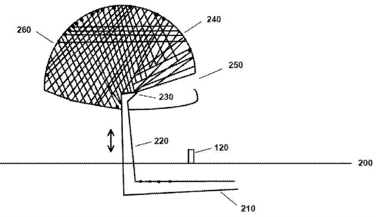
The solution that Ms. Porter came up with was to combine a detector to detect the presence of a nearby animal (to activate the sprinkler), with a moving fence that “moves with the rotary nozzle to enclose and protect the rotary sprinkler on all sides other than the nozzle” (to quote from the broadest claim). This fence is shown as reference number 240 in Fig. 2 of the Porter application:
Regarding the recited movable fence, the examiner cited a patent to Purtell, for a guard for an agricultural irrigation sprinkler. The only part of Purtell’s sprinkler that rotated along with the nozzles 20 and 22 was a mesh disc 40 at the top of the sprinkler, shown in Figs. 1 and 2 of Purtell:
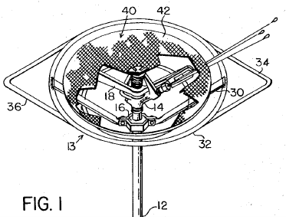
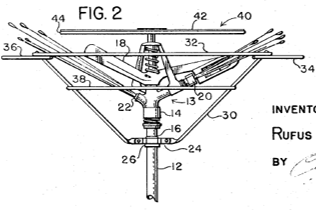
Sure, the disc 40 is disclosed in Purtell as rotating, but what about it being able to “enclose and protect the rotary sprinkler on all sides other than the nozzle”? The examiner took the position that other stationary parts of Purtell’s structure worked with the disc 40 to enclose and protect the sprinkler, and the claim did “not require the entire fence to rotate.”
This is hard to square with the claim language at issue, which explicitly refers to a “moving fence” as what does the enclosing and protecting, and offers no hint that part of that “moving fence” could somehow be stationary. The PTAB agreed, stating that “the claims require the entirety of the moving fence to move.” Appeal 2026-001639 (PTAB Aug. 17, 2026), at 3. The rejections being reversed, the application should soon proceed to allowance.
The result is not earthshaking, but it serves as a reminder that claim language needs to read closely, and that the burden is on the examiner to account for all the recited features in rejecting a claim. Plus, the sprinklers of America may soon be able to rest a little easier, with more protection from the country’s dogs.